Andorra Top Sightseeing
-
 Carmen Thyssen Museu1Museums
Since March 2017, the new Carmen Thyssen Andorra Museum has been a must-see gallery for lovers of the best art, especially painting from the 19th and 20th centuries. This museum occupies a total of 500 m2, of which 250 m2 are dedicated to the large exhibition hall. The entire surface is perfectly accessible and is equipped with the latest technical advances in museum matters. In this sense, new technologies play a fundamental role: thanks to the touch screens, the visitor will be able to interact directly with the work, enjoying different information and points of view. The exhibitions of the Carmen Thyssen Andorra Museum show some of the best works from Carmen Thyssen's private collection. From its headquarters in Madrid and from other artistic spaces it owns, pieces by masters of the 19th and 20th centuries reach Andorra, representatives of the main currents of their times: French Impressionism, North American Impressionism, Catalan Modernism, Fauvism, Cubism, German expressionism, North American hyperrealism ... Among them we can find the Mata Mua, the work of the master Paul Gauguin. Finally, the center also has works from the 16th century.
-
 Reig Factory Museum (Tobacco Museum)2Museums
This museum belongs to the Reig family foundation and is located in the family's former tobacco factory: Cal Rafeló, a 4-storey building located in the center of town. Tobacco production has been and is a fundamental economic activity for Andorra, for this reason the objective of the center is to disseminate the historical importance of this activity, and it makes use to a large extent of new technologies, with audiovisual projections and multimedia explanatory systems . * A museum to understand tobacco production: Learn, step by step, how this mass-market item was made and how it is made today. The cultivation, the arrival of the leaf to the factory, the gravy, the drying, the packets of stinging, the cigarette, the cigar, its customs control ... All the stages of this activity are part of the permanent exhibition, where you can also Get to know first-hand some of the machines and tools that were used in the factory. * Temporary exhibitions and activities: Along with the permanent exhibition, the center has other rooms and other spaces dedicated to temporary exhibitions of different themes, not always directly related to tobacco. In addition, the Reig Factory Museum is a living space in which numerous activities are organized throughout the year. * A pleasant and multimedia visit: The visit to the Reig Factory Museum is pleasant and entertaining, in part thanks to the multimedia system that guides the visitor at all times. Those who prefer, can join the group guided tours, with a duration of approximately 1 hour and a limit of 25 people.
-
 Church of San Climent de Pal3Religious
Sant Climent de Pal, is a real jewel of Romanesque art in Andorra. It is located in Pal, in the parish of La Massana, and is one of the oldest buildings that can be seen in the country. Inside and outside, elements of great artistic value are preserved, dating from the late eleventh century and later. This church is a construction of historical importance, as it is considered one of the oldest temples currently preserved in Andorra. Its construction dates back to the late eleventh century or early twelfth century, although it has also undergone modifications and extensions in more recent periods. In any case, the architectural ensemble retains very unique elements of the original project. For example, its bell tower, of Lombard style and three heights. Its twin windows with semicircular arches are striking, especially those on the top floor, as they are the only example of double twin windows in Andorra. The walls of its nave, which is rectangular in plan, are largely from the original Romanesque period. But the most surprising thing awaits inside Sant Climent de Pal. Here are preserved the most important religious and artistic objects of the temple. For example, a baptismal font made of granite, two processional crosses in polychrome wood and a carving of the Virgin of Remei, dating from the final phase of the Romanesque period in the country (13th century). There is also an altarpiece dedicated to Pope Clement I, the titular saint of the church, made in 1709. In fact, it is perfectly adapted to the apse, which was built between the late seventeenth and early eighteenth centuries.
-
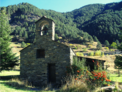 Sant Andreu del Prat del Campanar d'Arinsal4Religious
Privately owned, it is a 20th century reconstruction of the primitive Romanesque church destroyed by two avalanches.
-
 Sant Romà d’Erts5Religious
From the 18th century, built on a site near the old Romanesque chapel. It has a belfry with two belfries over the entrance and a porch. It preserves a baroque altarpiece from the old church with paintings evoking the martyrdom of Sant Romà
-
 Sant Joan de Sispony6Religious
Building constructed in the XVII century, very possibly on the foundations of an old medieval construction. Inside it preserves a pictorial cycle with representations of the Blessed Sacrament and the Passion of Christ by the painter Josep Oromí from the 19th century.
-
 Sant Ermengol de l’Aldosa7Religious
Building dated between the eighteenth and nineteenth centuries, with rectangular nave, quadrangular apse and belfry belfry. In its interior it conserves an altarpiece that combines a baroque table with paintings on canvas of the XIX century attributed to the painter Oromí de la Seu.
-
 Sant Andreu d'Arinsal8Religious
From the seventeenth century, with several later modifications and restored in its entirety between 1963 and 1964, according to a project of the Catalan architect Cèsar Martinell. The interior houses a small Baroque carving of Sant Andreu and a 17th century altarpiece dedicated to the Virgin of the Rosary, popularly known as the Virgin of the Snows.
-
 Sant Cristòfol d’Anyós9Religious
Romanesque base of the twelfth century but greatly modified between the sixteenth and nineteenth centuries. It still preserves a holy supper of protogothic style dated from the XIV century. It is possible to see an altarpiece made by Juan de Monterde of the XVI century and a pictorial cycle of the same epoch dedicated to San Cristóbal.
-
 Sant Iscle i Santa Victòria de la Massana10Religious
Parish church of the XVII century, built on an ancient medieval temple. From the medieval period a blessed pica and a wrought iron candelabra are preserved. The interior houses five baroque altarpieces, dating from the seventeenth and eighteenth centuries.
Download your Andorra guide!


Favorites
-
- You have currently no favorites. Click on to start planning your trip.